In a previous post, I mentioned one of my haiku would appear in the August edition of the journal, Better than Starbucks. Well, August is here, and my haiku has been published 😊. To date, this is my third published poem. If you’d like to check out my haiku online, you can read it here.ContinueContinue reading “Published Haiku!”
Category Archives: Traditional poetry
Nine

Cats are a part of my life—sometimes whether I like it or not, LOL. So I write about them. But a cat isn’t something that can be corralled into a poem, as if I could capture them with words. More probably, cats indifferently wander into my poems because they have nothing better to do, orContinueContinue reading “Nine”
Coloring Outside the Lines
Luc Bat is a Vietnamese form of poetry I blogged about earlier this year. The name means, “six, eight” and refers to the alternating lines of six and eight syllables. There’s also a fun rhyme scheme, which I diagram in my other post. “Coloring Outside the Lines” was my first attempt at a Luc BatContinueContinue reading “Coloring Outside the Lines”
It’s in the Genes—Kate McKamey
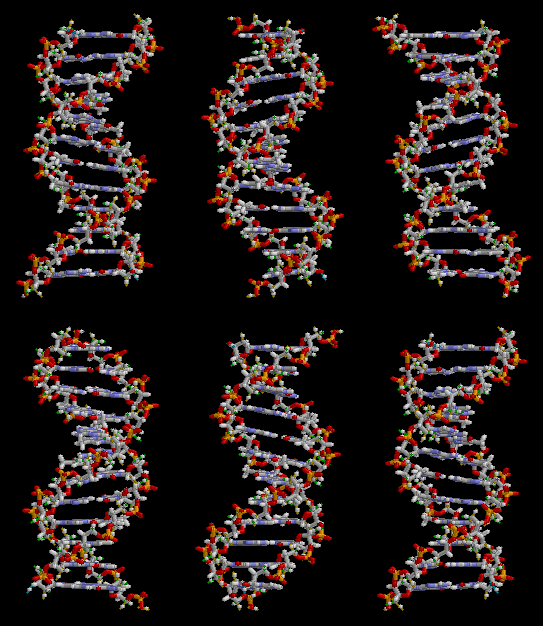
My daughter, Kate, attends high school at Wilson Hill Academy. Recently, her biology class had two projects: 1) do something artistic about genetics; 2) create a related meme. Kate opted to write six haiku about DNA and create a meme about writing poetry. We have writers on both sides of the family, so Kate comesContinueContinue reading “It’s in the Genes—Kate McKamey”
Late Afternoon

Tanka is a Japanese form of poetry I learned about last year. Haiku is a related form that started as part of Tanka. Haiku has a 5 syllable line followed by a seven syllable line, and ends with another 5 syllable line. Tanka begins with the same arrangement but adds two seven syllable lines atContinueContinue reading “Late Afternoon”
Clouds upon the Wind

Villanelle is a form of poetry I became interested in last year. It is a highly structured form comprised of 19 lines: five tercets (three line stanzas) followed by a quatrain (a four line stanza). The first line is repeated at the end of the second and fourth tercets. The third line is repeated atContinueContinue reading “Clouds upon the Wind”
Published Again!

I am happy to say that another of my poems will appear in the journal Better than Starbucks this August! The past couple months, I found myself writing a number of haiku and tanka, poetic forms that originated in Japan. Better than Starbucks has a section of their journal dedicated to haiku, so I decidedContinueContinue reading “Published Again!”
Look, Cat
In a previous post, I shared that I decided to be more intentional about writing and reading poetry in 2020. Many poetic forms have intrigued me over the years, so investigating poetry more has led me to new forms. Writing poems in different forms has been a way to challenge myself. Luc Bat is aContinueContinue reading “Look, Cat”
Janitor

Haiku is a Japanese poetic form I became acquainted with through the writings of JD Salinger. One of his recurring characters is Seymour Glass, and Seymour enjoys writing haikus. Haiku is a simple, three line form: a line of five syllables, a line of seven syllables, and a line of five syllables. Haiku began asContinueContinue reading “Janitor”

