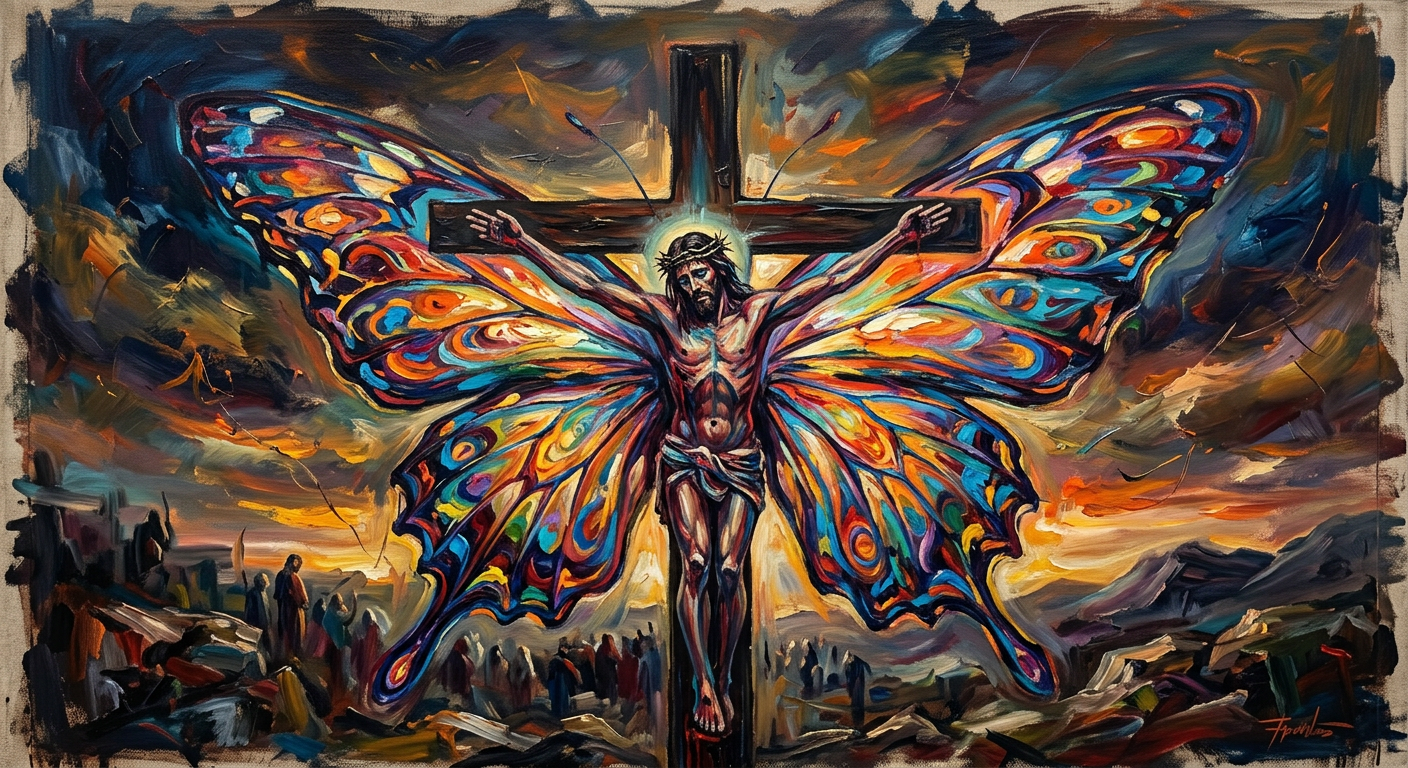
Today is Easter Sunday, the end of Holy Week, when Christians remember Jesus’s resurrection from the dead. Today’s poem, “Imago”, is from my fifth book, Voiceless Choirs: Psalms, Hymns, and Spiritual Songs.
Writing always involves a bit of mystery. Sometimes I get intuitions and pursue ideas without realizing their full depth. Much of that I attribute to the Holy Spirit hinting at a creative direction, helping me step beyond my own limits.
“Imago” surprised me in this way. It started with the alliteration of “chrysalis” and “crucifix.” From these words, I imagined Jesus on the cross as a butterfly spreading His wings. Jesus’s willingness to die for us is the deepest expression and image of God’s love.
Over the years, I’d heard the term “imago Dei,” meaning “Image of God.” When I came to the first section’s last line, I found myself wanting to say, “the imago of love” even though “the image of love” would sound more natural.
As it happened, I looked “imago” up to make sure I remembered what it meant, and was stunned at what I found. “Imago” in Latin means “image” in the sense of God’s image. But in English, imago’s primary meaning refers to a mature insect 😳 🤯 The way “imago” crowned the comparison I was making between Jesus’s crucifixion and a butterfly spreading its wings blew my mind! The Spirit knew something I didn’t and picked the perfect word 😁
“Imago” compares a butterfly’s life cycle to Jesus death, burial, and resurrection. Easter offers us this choice: die with Jesus and then rise with Him, or die on our own without the promise of resurrection. I am grateful for the hope—the only hope—this day offers to each of us. Happy Easter!
Imago

I.

From the chrysalis
of the crucifix,
blood-wings bloom
in a soaring agony,
the imago of love.

II.

The thorax pierced and pinned
to the sky,
each wing is spread—
     tenderly—
              to its full span

impaled in flight,
fluttering panes of stained glass
held in the rigor
of soaring display.

III.

He was a worm
dragging his belly
through the dirt
that we stepped on,
that was beneath
our noses and our notice

dirt that clung to him,
caked his small form,
and cocooned him in a tomb
where he waited to emerge
and to soar

sprinkling kaleidoscopes
over the bones of the earth
as the sun sang
through his wings.
 A Wandering Minstrel